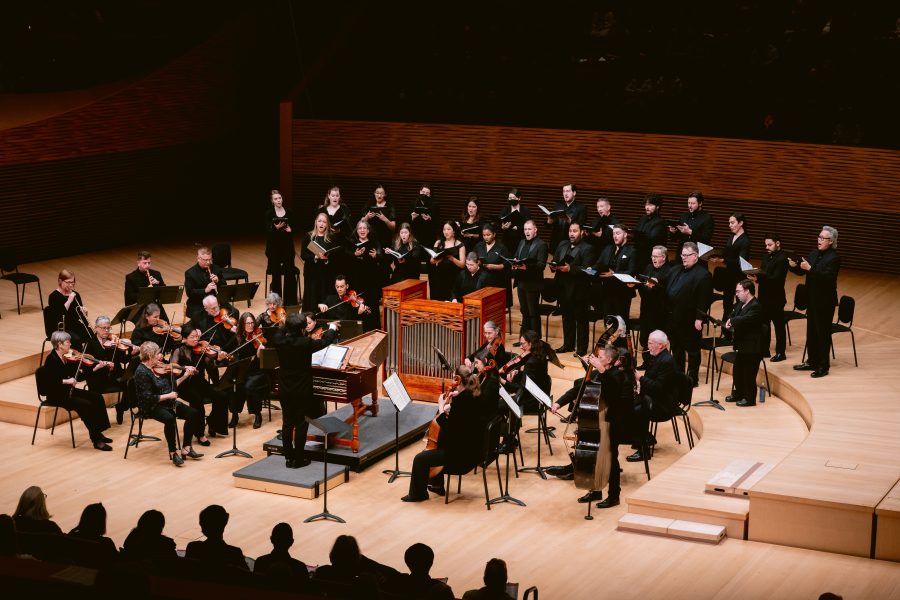
Bruce Lamott on KRBC 12/7 at 12:30

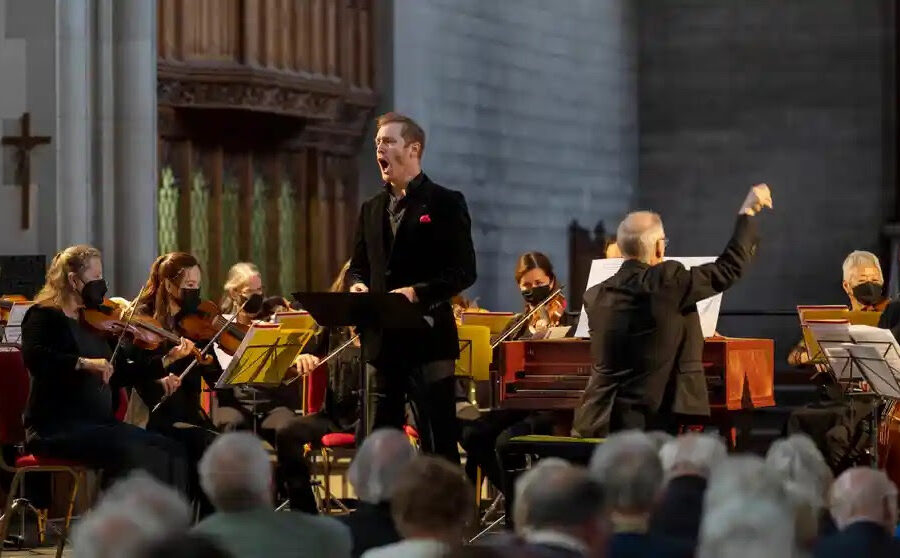
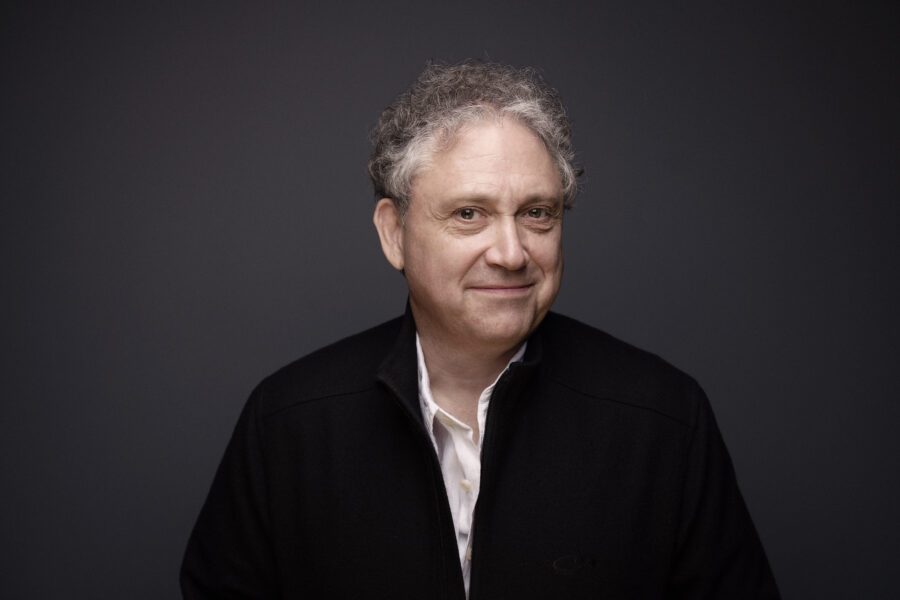
Bruce Lamott, director of the Philharmonia Chorale, will be interviewed today, December 7, at 12:30 pm on KRCB radio about Philharmonia Baroque’s performances of Handel’s Messiah on Saturday, December 8, at Zellerbach Hall in Berkeley and Sunday, December 9, at the Green Music Center in Rohnert Park.  Listen live at http://krcb.org/.

Posted in Uncategorized | Comments closed

A Tale of Two Fortepianos

A beautiful 6-octave Fritz fortepiano c. 1805-10 was prepared for last week’s performances of Beethoven’s Piano Concerto No. 4 with Emanuel Ax at the keyboard.   It was an instrument built by a Viennese maker at the time the concerto was written  The Fritz sounded marvelous in rehearsals, with a bright shimmer and three distinct timbres throughout its range.

As occasionally happens with period instruments, this fortepiano had some technical issues during the first concert of the series at the Mondavi Center in Davis. A hammer came loose from its hammershank during rehearsal, and in performance during the middle of the slow movement  two hammers came out of their capsules; fortunately Mr. Ax was able to improvise his way through the rest of the piece without these two keys.

What to do? Fortunately, Belle Bulwinkle, the owner who generously lent the instrument, had another period instrument available, a 6 1/2-octave Schott built in 1840. Piano Technician Janine Johnson worked all day to lower the pitch of the instrument in time for that evening’s concert in Atherton, interspersed with practice time for the soloist to acquaint himself with the new instrument. The Schott had a more full-bodied sound and a larger dynamic range of which Mr. Ax took complete advantage; one imagines Beethoven, with his quest for bigger and louder instruments as his deafness progressed, would have been pleased.

Posted in 32nd Season, About Period Instruments, Funny | Leave a comment

Beethoven’s 4th Program Notes

Ludwig van Beethoven was born in Bonn, then an independent electorate. His baptismal certificate is dated December 17, 1770, and he died in Vienna on March 26, 1827. He began work on his Fourth Piano Concerto in 1805 and completed the score early the next year. He was soloist in its first performance, a private one in March 1807 at the Vienna town house of Prince Franz Joseph von Lobkowitz (the Symphony No. 4 was introduced on the same occasion). He made his last appearance as a concerto soloist in the first public performance of this music, which was part of the famous Akademie in the Theater an der Wien on December 22, 1808, when the Fifth and Pastoral symphonies and the Choral Fantasy had their premieres along with the first hearings in Vienna of the Mass in C major and the concert aria “Ah! perfido,” not to forget one of Beethoven’s remarkable solo improvisations. The first North American performance was given on February 4, 1854, at the Boston Odeon by Robert Heller with Carl Bergmann conducting the Germania Musical Society.  The orchestra consists of flute, two oboes, two clarinets, two bassoons, two horns, two trumpets, timpani, and strings. The second movement is for strings only, and the trumpets and drums make their first appearance in the finale. Emanuel Ax plays the cadenzas by Beethoven.

The history of the contredanses is complex. The sketches for nos. 8 and 12 date from 1791/92 (before Beethoven arrived in Vienna), nos. 3 and 4 from 1795-96 (the years of the publications of his Opuses 1 and 2), and nos. 2, 7, 9-11 from 1801-02.  The first edition of the complete set for orchestra dates from April-June 1802; what is presumably Beethoven’s own arrangement of six of the dances for “harpsichord or Piano Forte” appeared in April 1802. Beethoven’s brother Kaspar Karl was involved in some mysterious fashion in nos. 8 and 12; it is unclear whether he actually composed them or merely arranged his brother’s sketches. Equally unclear is the date of the premiere of the individual dances within the set, since they were composed individually over a ten-year period. Most scholars assume that the majority was intended for the popular winter balls in Vienna.

Beethoven wrote the Symphony No. 4 in the summer and early fall of 1806. As noted above, it was first performed in March 1807, in Vienna. The first performance in the United States was given on November 24, 1849, by the New York Philharmonic Society, Theodor Eisfeld conducting. The score calls for flute, two oboes, two clarinets, two bassoons, two horns, two trumpets, timpani, and strings.


Concerto No. 4 in G major for Piano and Orchestra, Opus 58

Charles Rosen remarks in The Classical Style that “the most important fact about the concerto form is that the audience waits for the soloist to enter, and when he stops playing they wait for him to begin again.” Most of the Fourth Piano Concerto’s early listeners would have expected Beethoven to begin his new concerto as he began his previous ones and virtually all others they knew, that is, with a tutti lasting a couple of minutes and introducing several themes, after which the soloist would make a suitably prepared entrance.

Concerto is a form of theater. Beethoven, an experienced and commanding pianist, had a keen feeling for that, and his first three piano concertos (not counting the one he wrote as a boy of thirteen) and his Violin Concerto, all of which had been heard in Vienna by the spring of 1807, make something quite striking of the first solo entrance. The older Beethoven grew, the more imaginative he became. In the Triple Concerto, a beautiful, problematic, and unpopular work that was completed a couple of years before the Fourth Piano Concerto, the cello enters with the first theme, but a breath later than you expect and with a magical transformation of character. In the Violin Concerto, the solo arises spaciously from the receding orchestra; after that comes the Emperor Concerto, where right at the beginning three plain chords provoke three grand fountains of broken chords, trills, and scales. But it is here, in this most gently spoken and poetic of all his concertos, that Beethoven offers his most radical response to Rosen’s Law—to begin with the piano alone. It is a move without precedent. What is also remarkable is how rarely Beethoven, imitated so often and in so many things, has been copied in this stroke.

What the piano says is as remarkable as its saying anything at all at this point. Sir Donald Tovey recalled Sir George Henschel “happening to glance at a score of the Missa solemnis, open at its first page, putting his finger upon the first chord and saying, ‘Isn’t it extraordinary how you can recognize any single common chord scored by Beethoven?’ ” The orchestra’s exordial chord in the Emperor is an example, and so is the soft, densely voiced, dolce chord with which the piano begins the Concerto in G major. The whole brief phrase is arresting in its subtle rhythmic imbalance, but the still greater wonder is the orchestra’s hushed, sensitive and far‑seeing, harmonically remote response. The persistent three‑note upbeat makes this music tender cousin to the Fifth Symphony (in progress at the same time though completed only two years later). The rhythmic elasticity of the first solo‑and‑orchestra statement‑and-response foreshadows an uncommon range of pace.

The second movement has become the concerto’s most famous. Its comparison to Orpheus taming the wild beasts with his music was for years attributed to Liszt, though more recently the musicologist Owen Jander has pointed out that it was Adolph Bernard Marx “who first began to bring the Orpheus program of the Fourth Piano Concerto into focus” in his Beethoven biography of 1859. Even earlier than that, in his book On the Proper Performance of All of Beethoven’s Works for Piano (1842), Beethoven’s pupil Carl Czerny had suggested that “in this movement (which, like the entire concerto, belongs to the finest and most poetical of Beethoven’s creations) one cannot help thinking of an antique dramatic and tragic scene, and the player must feel with what movingly lamenting expression his solo must be played in order to contrast with the powerful and austere orchestral passages.”

In this second movement, the orchestra is loud, staccato, in stark octaves. The piano is soft, legato, songful, richly harmonized. At the end, after a truly Orphic cadenza—and Beethoven almost persuades us that he invented the trill expressly for this moment—the orchestra has learned the piano’s way. Only the cellos and basses remember their opening music, but just briefly, and their mutterings are pianissimo.

Until the conclusion of this sublime andante, this is Beethoven’s most quietly scored piano concerto. In the finale, which takes a charmingly Haydnesque, oblique approach to the question of how to resume the work after the evocative scene just played, trumpets and drums appear for the first time. Not that this movement is in any way grand; rather, it is lyrical and witty. It is also, with its two sections of violas, given to outrageously lush sounds—one more surprise in this most subtle, suggestive, and multi‑faceted of Beethoven’s concertos.


Twelve Contredanses for Orchestra, WoO 14

The Twelve Contredanses originated in the rustic English country dance in which the dancers were arranged face to face, “one set against another,” performing prescribed figures in two lines, a circle, or a square. Imported to the French court at the end of the 17th century, it became the most popular French dance of the 18th century, eclipsing the minuet. (The contredanse itself faded in popularity around 1840 in favor of waltzes and polkas.) Contredanses are both in triple and duple meters; according to one 19th-century description, “all that is necessary is that the strains should be in four or eight bar phrases to accompany the several movements, and every need is satisfied.”

Undoubtedly the most famous of the set is no. 7, which features a tune Beethoven used on four occasions: here, the ballet The Creatures of Prometheus, The Eroica Variations, and the Eroica Symphony. In 1980 Shin Augustinus Kojima corrected the long-held chronology, arguing that the ballet came first and that Beethoven recycled the melody and famous bass into the contredanse. The beloved tune and its bass part probably originated in Beethoven’s improvisation in April 1800 at the second of his two duels with the brilliant touring pianist Daniel Steibelt, famous for being the first composer to develop pedal markings and for the invention of the tremulando. Trying to humiliate Steibelt, Beethoven grabbed the cello part of one of Steibelt’s piano quintets from a stand, turned it upside down, and used it as the bass for an extended improvisation that resulted in the creation of the lilting tune — William Meredith, Ph.D


Symphony No. 4 in B‑flat major, Opus 60

Beethoven’s work on the Fifth Symphony brackets that on the Fourth. Robert Simpson discusses their relationship in his illuminating book­let on the Beethoven symphonies for the BBC Music Guides: “[The B‑flat major symphony] is highly compact, as the C minor was going to be, yet lighter in character, as if Beethoven, unsure how to release the thing that roared in his head like a caged tiger, turned his attention to less obstreperous inhabitants of his extraordinary domain. If the Eroica is like a noble stallion, the C minor and B‑flat symphonies might be thought of as belonging to the cat family, the one fierce, the other lovable, but both sharing compact suppleness of movement, a dangerous lithe economy that makes them akin, and toge­ther, different from their predecessor. The Fourth belongs to the Fifth—and ever so much as in the Stygian darkness of its introduction, abruptly obliterated by vivid light.”

It has often been observed that Beethoven’s even‑numbered symphonies and concertos tend to be more lyrical, less aggressive than their odd‑numbere­d neighbors. To Robert Schumann, the Fourth Symphony was “a slender Grecian maiden between two Nordic giants.” Beetho­ven spent the summer of 1806 at the Silesian estate in Grätz of Prince Carl von Lichnowsky, one of the most steadfast and knowledgeable of the compo­ser’s admirers during his early years in Vienna. It was through Lichnowsky that Beethoven met Count Franz von Oppersdorff, to whom he eventually dedicated the new symphony. Oppersdorff maintained an excellent orchestra, insisting that all persons employed in his household be proficient on some instrument.

As Haydn did in most of his last symphonies and as in his own first two, Beethoven begins with a slow preface, and, while the key signature does not admit it, the music is actually in B‑flat minor. The most musical of the guests at the Palais Lobkowitz in 1807 would have been more aware than most of us today of just how slowly this music moves—not so much in terms of notes per minute as in the passage of events. The harmony stands all but still, and the effect of suspended motion is underlined by the pianissimo that lasts—as Beethoven stresses four times—unbroken through the first twelve measures. Those twelve measures lead us, with exquisitely wrought suspense, back to the beginning. The five octaves of B‑flat are sounded just a bit more emphat­ically than before, but the continuation is the same, a pianissimo expansion of the note G‑flat. The effect of the G‑flat is delicately dissonant, unstable, and the first time Beethoven resolves it quite normally down a half‑step to F, the note that has the most powerful magnetic pull back toward home, to B‑flat. This time, however, Beethoven treats the G‑flat as though it were in no need of resolution and continues by submitting to its own magnetic pull in the direction of B‑natural, which, in the context of a universe whose center has been defined as B‑flat, comes across as an absolutely reckless excursion.

Beethoven finds his way back to the threshold of his proper harmonic home—not, of course, without adventure and suspense—and the first entrance of the trumpets and drums helps push the music into a quick tempo. The mate­rial is of an almost studied neutrality. The life of this ebullient allegro resides in the contrast between passages when the harmonies change slowly (as they mostly do) and others in which harmonic territory is traversed at a great rate, in the syncopations, the sudden fortissimo outbursts, and in such colorful details as the stalking half‑notes in pianissimo. The development ventures a few moments of lyric song, but most of the orchestra is impatient to get on and to get back. The task of getting back to the home key and the first theme sends Beethoven into one of his most wonderful passages, in which wit and mystery are deliciously combined.

The Adagio is an expansive, rapt song; rarely does Beethoven insist so often on the direction cantabile. Before the song begins, we hear a measure of tick­ing accompaniment in the second violins. What is characteristic of Beethoven is the refusal of that accompaniment to disappear. It remains an insistent presence and a fascinating foil to the flowing melodies. Not until the Ninth would Beethoven again write a symphony with a really slow movement.

Concerned with bringing the scherzo in step with the expanding scale of the symphony as a whole, Beethoven makes an extra trip around the scherzo­-trio‑scherzo cycle. In the finale, certain of the characters from the first move­ment reappear, newly costumed, but this last Allegro (ma non troppo) is a more relaxed kind of movement than the first (Allegro vivace).

Having begun with Schumann, we can end with some good words of his: “Yes, love [Beethoven], love him well, but never forget that he reached po­etic freedom only through long years of study, and revere his never‑ceasing moral force. Do not search for the abnormal in him, but return to the source of his creativeness. Do not illustrate his genius with the Ninth Symphony alone, no matter how great its audacity and scope, never uttered in any tongue. You can do as much with his First Symphony, or with the Greek‑like slender one in B‑flat major!”—Michael Steinberg

Michael Steinberg, the San Francisco Symphony’s program annotator from 1979 to 1999 and a contributing writer to the Symphony’s program book until his death in 2009, was one of the nation’s pre-eminent writers on music. His books are available at the Symphony Store in Davies Symphony Hall and at sfsymphony.org/store. The notes on Beethoven’s Piano Concerto No. 4  and Symphony No. 4 are copyright © San Francisco Symphony and reprinted by permission.

William Meredith, Ph.D.; Director, The Ira F. Brilliant Center for Beethoven Studies; Executive Director, The American Beethoven Society and Professor, School of Music and Dance, San Jose State University

Beethoven’s Fourths Event Page

Posted in 32nd Season, Composers, Concerts, Program Notes | Leave a comment

Vivaldi’s Four Seasons Tour


Nicholas McGegan


Elizabeth Blumenstock


Nicholas McGegan, conductor
Elizabeth Blumenstock,
violin

Vivaldi’s beloved set of violin concerti known as The Four Seasons is perhaps the culmination of the middle Baroque period of Italian music, which embraced two parallel lineages in Northern Italy and Naples. Corelli was a pivotal figure, a virtuoso violinist whose influence on training in violin performance influenced all who came after him, especially his Northern Italian pupils Locatelli and Vivaldi. At the same time, another Italian music center in Naples produced composers such as Durante and his pupil Pergolesi, whose contributions ranged from sacred music to opera buffa.

Program
CORELLI Concerto Grosso Op. 6 No. 7 in D major
PERGOLESI Sinfonia in F major
VIVALDI Violin Concertos, Op. 8, Nos. 1-4 The Four Seasons
Violin Concerto in E major, RV 269, La primavera (Spring)
Violin Concerto in G minor, RV 315, L’estate (Summer)
Violin Concerto in F major, RV 293, L’autunno (Autumn)
Violin Concerto in F minor, RV 297, L’inverno (Winter)
LOCATELLI Concerto Grosso Op. 7, No. 6 in E-flat major, Il pianto d’Arianna
DURANTE Concerto No. 5 in A major

Posted in events, Special Events, Uncategorized | Leave a comment

New CD Release Brahms’ Serenades on October 9

San Francisco, CA – September 24, 2012 – Philharmonia Baroque Orchestra announces the release of Brahms’ Serenades on October 9, the fifth disc to be released since the 2011 founding of Philharmonia Baroque Productions. Music Director Nicholas McGegan leads Philharmonia Baroque inthis disc of Brahms’ Serenades, recorded in live performances March 10 and 11, 2012 (Serenade No. 2) and February 13 and 14, 2010 (Serenade No. 1) at Berkeley’s First Congregational Church.

Click here to preorder/order or pick up a copy at all performances October 3, 5-7, 2012.

Brahms SerenadesOf the live performances in the San Francisco Chronicle critic Joshua Kosman stated that Maestro McGegan “embraced every opportunity to give the music a musky physicality – especially in the outer movements, whose rhythmic force was arresting.”

All Philharmonia Baroque Productions recordings are distributed by harmonia mundi in the U.S., U.K., Germany and Austria and are available in both standard CD and digital download formats from Amazon, iTunes and other online outlets as well as all major retailers and the Philharmonia Baroque Orchestra website, www.philharmonia.org. All five of the Philharmonia Baroque Productions recordingsare produced and engineered by David v.R. Bowles, who has produced the orchestra’s recordings since 1996.

Critical acclaim has been high for Philharmonia Baroque’s recording label with The New York Times calling the first release of Berlioz’s Les Nuits d’été “almost forbiddingly beautiful” and www.philharmonia.org proclaiming the third release of Vivaldi’s The Four Seasons “brimming with color, vitality, and imaginative interpretation.” The most recent release, Handel’s opera, Atalanta, was acclaimed by the San Francisco Chronicle as “…magnificent…the most vibrant, exhilarating stretch of musical showmanship this organization has offered in many a long season.” Named Musical America’s Ensemble of the Year in 2004, music critic Joshua Kosman said, “This adventuresome band has carved out a niche as the nation’s liveliest purveyor of period performances. The uncommon brilliance of its instrumental playing infuses the historical-performance enterprise with a vitality and zest that are worlds removed from dull conformity to the dictates of scholarship.”

Among the most-recorded period-instrument orchestras in the United States or in Europe, Philharmonia has made thirty-three highly praised recordings – including its Gramophone award-winning recording of Handel’s Susanna – for harmonia mundi, Reference Recordings and BMG. In 2011, the orchestra launched its own label, Philharmonia Baroque Productions, with an acclaimed recording of Berlioz’ Les Nuits d’été and Handel arias featuring mezzo-soprano Lorraine Hunt Lieberson. The second CD release, Haydn: Symphonies No. 104 “London”, No. 88, No. 101 “The Clock,” was nominated for a GRAMMY® Award for Best Orchestral Performance. The ensemble then went on to release a commended recording of Vivaldi violin concertos including The Four Seasons featuring violinist Elizabeth Blumenstock. These last five releases on the Philharmonia label – including the upcoming Serenades – are the first the orchestra has issued since 2007, when it self-released live recordings of Jake Heggie’s To Hell and Back and Beethoven’s Symphony No. 9.

Click here to preorder/order or pick up a copy at all performances October 3, 5-7, 2012.

Posted in Listen to Music, Recording | Leave a comment

Dioclesian Program Notes

Animated Rendering of Dioclesian's "The Masque from Act V"

The Prophetess; or, The History of Dioclesian (Z. 627)
by J.J.G.Muller-van Santen

Henry Purcell (1658/9-1695) was born in London at the very end of the Commonweath period. During Oliver Cromwell’s Puritan rule public music, both sacred and secular, had been forbidden and the public theatres were closed. Purcell’s father and uncle, both musicians, must have had difficulty making ends meet. Henry was still a baby at the Restoration of the Monarchy in 1660, when Charles II came to the throne. Charles, who adored the theatre and had been in exile both at the glittering court of his uncle Louis XIV in France and that of his sister Mary (married to Stadholder Willem II) in Holland, returned to England determined to equal their musical and theatrical splendor without risking the extravagance which had cost his father the throne and eventually his head. Louis XIV helped by giving him “twenty-four violins” (that is, string players and their instruments) to take home with him; the Court Music was reinstated, the theatres reopened. Charles enthusiastically allowed women on the public stage for the first time and the elder Purcells were fully employed.

Henry Purcell inherited the family musicality and at six or seven he became one of the  Children of the Chapel Royal (wearing the same dress uniform Chapel boys wore at the 2011 royal wedding) and was given a solid musical education by teachers who played and composed music for the church, the court and the theatre. So from early childhood he was exposed to the three branches of musicianship in which he was to excel.

At twenty he succeeded his teacher John Blow as Westminster Abbey organist.  and around the same time he started composing incidental music for plays performed at the Dorset Garden Theatre, which had been built specifically for what has been called “multi-media spectaculars”. Dorset Garden or The Duke’s Theatre (becoming The Queen’s when James II succeeded his brother in 1685) was run by the actor/manager Thomas Betterton, who was involved in every aspect of the performances.

Dorset Garden had moveable perspective scenery, which slid onto and off the stage from the sides, running in grooves. “Machines” carrying people could come down from above and traps in the floor allowed devils and all kinds of objects to appear. One of the main attractions of the theatre was the rapid scene changes in full sight of the audience, as the curtain did not close during performances. The necessary ropes and capstan were manned (out of sight, presumably under the stage) by ex-sailors under the direction of a boatswain who gave his orders using a whistle. Whistling behind the scenes was strictly forbidden, for obvious reasons, and is still a serious no-no in the English theatre.


Purcell’s first major theatrical work was the fifty-minute chamber opera Dido and Æneas, which the latest research dates to about 1683, but is known only in the 1689 version for the Chelsea school run by Mrs. Priest, wife of the dancing master and Dorset Garden choreographer Josias Priest. The libretto was by the playwright Nahum Tate, for several of whose plays Purcell had already composed music.

Charles II died in 1685 and was succeeded by his brother James II, who was at least as enthusiastic a theatre goer and patron. He once even lent the actors his coronation robes for a play. In 1688 James was deposed in favor of his daughter Mary II and her Dutch husband William III. William spent more money on warfare than he did on music which, in contrast to his wife, he seems not to have enjoyed. John Dryden criticised him regarding the war in Ireland in his Prologue to The Prophetess; or, Dioclesian which prologue was suppressed after the first night. William’s lack of (financial) interest may have been one of the reasons why Purcell composed increasingly for the stage from 1689 on.

The Prophetess; or, Dioclesian, 1690, was the first of Purcell’s so-called ‘semi-’ or ‘dramatick’ operas, composed for Dorset Garden Theatre. Unlike the through-composed Dido and Æneas, his dramatic operas were full-length plays with spoken text, instrumental and vocal music and dance. The general structure consisted in the First and Second Music while patrons entered the theatre. The cheap seats were backless benches which sometimes collapsed under the shifting weight of the noisy crowd. This problem was sometimes utilized for dramatic purposes: if a scene change could not be effected quickly enough, someone would be stationed in the back of the hall to break a stick at the operative moment. Everybody in the audience would turn around to see who had landed on the floor and when they turned back, the scene would have changed.

For a fee, orange sellers would add a billet-doux  to the orange some gallant would send a “lady” and people were constantly going in and out. The more expensive seats were in the balcony and some boxes had lattices so nobody could see what was going on behind them. However, it could sometimes be heard, on occasion stopping the show.

The  Curtain Tune (i.e. overture: the curtain went up at the beginning and normally did not fall again until the end of the performance) was followed by a five-act play with musical interludes, the acts often ending in masques; that is, musical episodes without spoken text, which originated as English court entertainments. The masques were adorned with spectacular costumes and scenery and usually had a mythological content bearing a metaphorical relationship to the plot of the opera.

The original play, The Prophetess, was written by John Fletcher and Philip Massinger in 1623 and contained much less music. The adaptation is mainly Thomas Betterton’s and “it gratified the Expectation of Court and City” according to the prompter, John Downes.

The story is loosely based on the career of the Roman emperor Diocletian (who lived around 300 CE) and is superficially about a power struggle in ancient Rome and warfare against the Persians, but actually has the same theme as many other operas: the conflict between love and duty.

Synopsis:

Act I Numerianus, one of the three Roman emperors, has just been murdered. His brother Charinus offers co-emperorship and his sister Aurelia both a reward and marriage to whoever kills the murderer.

Drusilla, who has her eye on a rank-and-file soldier in the Roman army called Diocles, lives with her aunt Delphia, a prophetess. To balance this, Diocles has a nephew called Maximian, also a soldier. Delphia tells Diocles he will be emperor when he has killed a great boar, after which he will marry Drusilla. Diocles believes her and starts slaughtering all the wild boars he can find. Nothing else happens. After a time he realises (with a bit of help) that a soldier named Volutius Aper (Aper= wild boar in Latin) is the murderer. There is no music in this act.

Act II: Diocles leads Aper, in chains, onto the stage and kills him- hardly a heroic deed. However music, struck “from the Spheres,” shows that the Gods approve and the soloist sings Great Diocles the Boar has killed, followed by Let the Soldiers Rejoyce and Sing Io’s. Pallas Athene, goddess of war and Venus, goddess of love, share the honor, as Venus inspires “thund’ring Jove” in G major. Note that when the opera opened, William was away fighting in Ireland and Mary was ruling England alone.

Then Charon the boatman who ferries the dead across the river Styx tells the living to observe the necessary rites for ensuring that the dead Numerianus reaches the farther shore safely, in Royal C major for the dead emperor in accordance with contemporary convention. Sound all your instruments of War/Fifes, Trumpets, Timbrals play; the call to musical arms becomes a very slow Italianate Symphony for Trumpets and Violins back in G major and modulating to C for royalty again after the symphony, for the second half of the quatrain: Let all Mankind the Pleasure share/and bless this happy Day on which Diocles, who has been elected emperor by the army, will be invested. The transitions in both the music and the tripartite text on funeral-war-investiture, all within one musical event, are quite abrupt, anticipating the problems in the next scene. Purcell’s setting meticulously follows the windings of the plot.

Soloist: Let the priests with processions the hero attend; Chorus: All sing great Diocles’ story. Beautiful Princess Aurelia, the former emperor’s sister, again offers to marry the hero and Diocles, now styled Dioclesian, is eager to do so, forgetting all about Drusilla. As the marriage ceremony begins, Delphia and Drusilla are hovering unseen over the stage in Delphia’s dragon chariot (every self-respecting magician had one on the 17th-century stage). Delphia is furious and sends a monster to interrupt the proceedings. Thunder! Lightning! according to the stage directions. Everybody runs away as a Monster comes slowly downstage and metamorphoses into a Dance of Furies to Purcell’s dramatic music.

Act III

The scene shows “Hangings and figures Grotesk” painted on them, later replaced by dancers coming “off” the curtains and others replacing them there. There is a literal Chair Dance, a dance by chairs.

Aurelia is given a charm by Delphia, making her fall in love with Dioclesian’s nephew Maximian, now styled Maximinian. He has been in love with her all along, as shown in When first I saw the bright Aurelia’s eyes, a song added for a 1693 revival. Aurelia is portrayed as being very haughty in a sub-plot involving a Persian captive princess, but Maximinian’s What shall I do demonstrates that he is oblivious to this. She falls into his arms as Dioclesian enters without her recognising him. All except the bereft Dioclesian leave the stage; enter Delphia, who chides him. He promises (again) to marry Drusilla and back comes Aurelia, the spell now having worn off. She reclaims Dioclesian, he follows her away and Delphia makes threats involving the Persian army.

In Act IV Maximinian and Aurelia are captured by the Persians and Dioclesian decides this is his fault for breaking his promise to Delphia. Reconciliation. Just to show him what would have happened if he had not repented, Delphia conjures a scene with Aurelia’s tomb, which eventually turns into a Butterfly Dance, a scene borrowed almost literally from Lully’s Cadmus et Hermione. An off-stage battle follows, the prisoners are freed and Dioclesian triumphs once again. Sound Fame, who is personified blowing her trumpet; a virtuoso part for one of the famous Shore family of players.

Let all rehearse (meaning ‘repeat’ at that time) the story of our hero Dioclesian. In Act V he pardons the King of Persia, returns his crown and hands over his own to Maximinian, along with Aurelia’s hand. Dioclesian chooses love in a cottage with Drusilla. Delphia, satisfied, offers the illustrious company a closing masque, with Cupid as Master of Ceremonies.

Call the Nymphs and the Fawns (=fauns) from the woods followed by a page and a half of stage directions calling for four platforms descending and a number of orange trees (symbolising William of Orange) rising from under the stage.

The throne on the topmost stage is for Cupid.  Behold O Mightiest of Gods, at thy Command we come. Two Wood-Gods sing Ah! The sweet Delights of Love, followed by a Faun singing what is in fact the credo of the opera; Let Monarchs fight for Pow’r and Fame…Astrea’s all the World to me. Then comes another song added for the revival, the famous Since from my Dear. The singer is rudely torn from her sight, to die ambiguously; to seek oblivion too in a bottle, for in comes Bacchus. Drinking song: The Mighty Jove, followed by a dance. Several love songs and duets, include a song by Two Youths, All our Days and our Nights, which had a second stanza, Let us Dance, let us Sing, found in the word-book but not set until the 1693 revival. This pastoral interlude culminates in Be Gone, importunate Reason; in short: seize the day. The masque terminates in the final trio: Triumph, Victorious Love with its chaconne ground bass and the chorus extolling the Glory of Almighty Love.


Posted in 32nd Season, Program Notes | Leave a comment

Handel’s Messiah Tour

Masaaki Suzuki

Sherezade Panthaki

Fabiana González

Dann Coakwell

Dashon Burton

Bruce Lamott

Masaaki Suzukiconductor
Sherezade Panthakisoprano
Fabiana Gonzálezalto
Dann Coakwell, tenor
Dashon Burton, bass-baritone
Philharmonia Chorale, Bruce Lamott, director

Handel’s beloved Messiah premiered in Dublin in 1742 and combines Old and New Testament texts concerning prophecies of a Messiah, or savior. One of the most loved of all musical compositions, it has become an integral part of any holiday season. Join guest conductor Masaaki Suzuki—director of Bach Collegium Japan, and a formidable Handelian—along with the incomparable Philharmonia Baroque Orchestra and Chorale, and soloists from Yale University’s Institute of Sacred Music for a joyous performance of this extraordinary 18th-century masterpiece.

Program
HANDEL Messiah, HWV 56

Philharmonia Baroque’s appearance at the Green Music Center is sponsored, in part, by Qualia Wines/Kivelstadt Vineyards.

Posted in 32nd Season, events, Special Events | Tagged , , , , , , , , , , , , | Leave a comment

Impeccable…Evocative

You’ve never heard anything like it…Winter is simply staggering and reason enough to own this CD…Blumenstock [is] as fearless as she is accomplished…Sonics are perfect…Wow – another Four Seasons.  I mean it: Wow.

-Robert Levine, Stereophile review of Philharmonia Baroque’s new Vivaldi: Four Seasons and Violin Concertos recording (July 2012 issue).

Posted in Recording | Tagged , , , | Leave a comment

“Beethoven Songs & Haydn Trios” – Program Notes for June 3

Music Director Nicholas McGegan contributes these program notes for the June 3 concert that opens the Berkeley Early Music Festival.

In the years before a television took over every living room, no parlour was thought to be complete without a piano. In many households chamber music was something you made at home rather than went to hear in a concert hall, if that was even possible outside a major city.  Playing the piano, like dancing, was regarded as an essential part of a child’s upbringing, especially a young lady’s. Young men customarily learned to play the violin, flute, or cello, the latter being the most aristocratic of all.

The present Prince of Wales is the third, and probably not the best, princely cellist in his family. The Duke of Wellington’s father, the Earl of Mornington, is described as “the first member of the British aristocracy who dared to walk through the London Streets openly and unashamedly carrying a violin case.” Amateur music making was certainly an aristocratic pastime as can be seen in this cartoon of the Pic-Nic Orchestra by James Gillray, which I am lucky enough to own.

Cartoon of the Pic-Nic Orchestra by James Gillray

Cartoon of the Pic-Nic Orchestra by James Gillray

In more ordinary families, music making helped fill the hours after dinner, the daughters at the piano or singing, the father and brothers playing violin or cello. Some daughters, such as Mary Bennett in Pride and Prejudice occasionally didn’t know when to stop, provoking her father’s reproof: “That will do extremely well, child. You have delighted us long enough.”

Another Gillray engraving shows the potential hazards of such a musical evening in a house of a rather pretentious farming family. The result of all this domestic musical activity was a ready market for all kinds of chamber music:

Farmer GIles & his Wife Showing Off their Daughter Betty, by James Gillray

Farmer GIles & his Wife Showing Off their Daughter Betty, by James Gillray

piano sonatas with flute or violin, string quartets, piano trios, and song with trio accompaniment. Much of tonight’s concert is based on this type of repertoire, most of which was published in England, even though it may have been written by composers based as far away as Vienna.

In 1812 Beethoven wrote his Allegretto for piano trio expressly for Maximiliane Brentano, the daughter of some close friends. As he wrote on the manuscript: “for my little friend Maxe Brentano to encourage her with her piano-playing.” She was about ten years old at the time and must have been quite the prodigy. The manuscript is not only one of the neatest that he ever wrote (she probably played from it) but also Beethoven put fingerings in the piano part to guide young Maxe. She clearly continued her piano lessons because a decade later Beethoven dedicated his magnificent late Piano Sonata op. 109 to her. This elegant delightful trio was never published in his lifetime.

Portrait of Franz Brentano and his two daughters by Nikolaus Lauer. Maximiliane is the elder of the two.

Portrait of Franz Brentano and his two daughters by Nikolaus Lauer. Maximiliane is the elder of the two.

The first page of Beethoven’s manuscript with the dedication to Maximiliane Brentano.

The first page of Beethoven’s manuscript with the dedication to Maximiliane Brentano.

The second half of the eighteenth century saw a revival of interest in German as a language for poetry and drama. Prior to Goethe and his contemporaries, French had been the language of choice for verse, belles lettres, and even polite conversation, just as Italian was the language of opera. However, it didn’t take long for composers to start setting these lyrics to music, though the flowering of German lieder would not come until the following century. Tonight we will hear two fine lieder by Mozart, one of which is a setting of a text by Goethe. Unlike many German songs of the period (including some of Schubert’s) where each verse is set to the same music like a modern hymn, these gems are through-composed.

Frantisek Kotzwara was famous for two things for over a century: his piece The Battle of Prague and his sensational exit from this world. He most probably wrote the work for piano in 1788 while he was living in Dublin and it remained in the repertoire for over a hundred years. The actual battle was fought in 1757 between King Frederick the Great of Prussia’s army and the Austrians. The piano piece tries to give the flavour of the sound and fury of the battle, complete with booming cannons, charging cavalry and the whirring of rifle shots. In the era before cinema organs such pieces were wildly popular; indeed, in Boston it was said that no concert was considered complete without it. Many early pianos had the kind of percussion effects added to them that you will hear employed this evening.

Percussion mechanism in the Guggenberger fortepiano.

Percussion mechanism in the Guggenberger fortepiano.

Mark Twain mentions exactly this type of piano in Huckleberry Finn:

“There was a little old piano, too, that had tin pans in it, I reckon, and nothing was ever so lovely as to hear the young ladies sing ‘The Last Link is Broken’ and play ‘The Battle of Prague’ on it.”

Kotzwara’s demise was one of the most spectacular among the sometimes macabre and bizarre deaths of composers. In 1791, he visited a courtesan called Susannah Hill, offering her two shillings to emasculate him with a knife. Not surprisingly, she refused (two shillings being about the price of a good dinner back then, though I somehow doubt that money was really the issue here). He then put a rope around his neck which he tied to the doorknob. In the course of their subsequent amours he apparently died (one hopes happily) of asphyxiation.  Later that year, Miss Hill was sent for trial at the Old Bailey where she was acquitted of murder. Lurid pamphlets narrating the whole episode were widely distributed. The trial was the talk of the town and Haydn, who was in London at the time,
certainly knew about it, though he discreetly only mentions the composer’s name in his diary leaving the rest to one’s imagination. The Internet is full of discussion of Kotzwara’s demise with works ranging from the sensational to articles in medical journals. In the past few years some people have even imitated him (with fatal success), including an English Tory politician and an American movie star hoping to revive his former “glory.”

Kotzwara's death

Engraving showing Kotzwara's death

In 18th century Europe almost everything classy, with the exception of grand opera, originated in France. The works of Rameau, because of their rarified, hot-house style, had little appeal outside Paris and the Court. However a new generation of composers who started writing in the 1760’s changed all that. Influenced perhaps by the musical writings of Rousseau, the Baron Grimm and the Encyclopédistes, they rejected what they saw as the artificiality of the Ramelian manner in favour of what they called vraisemblance, or truth to nature. Gone were the opéra’s gods and goddesses, and instead on to the stage came real French men and women: Parisian hairdressers, grasping landlords, servants of every livery, country bumpkins and shepherdesses who actually worked, not the Little Bo Peep look-alikes you see in the paintings of Boucher and Fragonard.

Some of the plots were based on English novels such as Tom Jones, which was thought to be tremendously racy in Paris, or plays from the London Theatre. Composers wrote in a simpler style influenced by Italian opera buffa with tunes you could hum or sing at home. Instead of recitative, they preferred spoken dialogue. The result was opéra comique, which became the rage all over Europe and continued in the following century to be the format for the operettas of Offenbach, Johann Strauss, and Gilbert & Sullivan.

Of the first generation of these composers, the most famous is Philidor, partly because he had a second career as the best known chess player in Europe. However, Pierre-Alexandre Monsigny is certainly not a composer to be despised; indeed several of his opéras-comiques have been revived in the USA in recent years by Opera Lafayette based in Washington, DC.  The plot of Le Roi et le Fermier comes from an English play by Robert Dodsley. The song we’ll hear this evening shows off Monsigny’s gift at its finest: a simple, charming, heartfelt tune whose qualities have stood the test of time. In fact, this very song was a favourite of Marie Antoinette, Queen of France, who actually performed the role of Jenny onstage in Versailles.

François-Adrien Boieldieu’s most famous work is La Dame Blanche, which is an opera based on the novels of Sir Walter Scott, an author whose books also inspired Berlioz and Donizetti. This charming song is a Barcarolle, the trademark music of Venetian gondoliers.

Illustration of François-Adrien Boieldieu by Louis Léopold Bouilly c. 1800.

Illustration of François-Adrien Boieldieu by Louis Léopold Bouilly c. 1800.

In 1790, Haydn’s patron Prince Nicholas Eszterházy died and was succeed by his less musically inclined son Anton. He disbanded his father’s orchestra and opera company. As a result, Haydn was free to travel and see the world. A timely invitation arrived in the person of Johann Peter Salamon, a violinist and composer who had a very successful concert series in London. Haydn’s music was well known there, but I suspect that he had little idea what a sensation his arrival in the British capital would cause. He was amazed by the size and bustle of London but less thrilled by the air; he wrote that the fog was so thick you could spread it on bread.

Nothing prepared him for the star treatment he received. He had been born in a tiny farming village east of Vienna, had lived much of his life working in a princely household miles from anywhere, had never seen the sea let alone been in a ship, yet now he found himself fêted by the royal family and other members of high society in the largest city in the western world. He was astonished when he was invited to enter through the front door of each grand house whereas in Vienna or the Eszterházy palaces he had always been expected to use the servants’ entrance. He wrote that at a concert “The Prince of Wales sat on my right side and played with us on his violoncello, quite tolerably…. He is the most handsome man on God’s earth; he has an extraordinary love of music and a lot of feeling, but not much money.”

Clearly, he was having the time of his life. And not only on the public stage: he was over sixty years old and his private life was enjoying an Indian summer too. He met and fell in love with Rebecca Schroeter, some twenty years his junior. She was the Scottish widow of a German pianist who had taught the Royal children, and not only was she pretty but also of independent means. Haydn kept her love letters to him and they make charming reading, though one doesn’t have to believe him when he claimed that he only kept them in order to practice his English. Later he said that he would have married her if only Mrs. Haydn hadn’t been alive and well back in Vienna.

Drawing of Dr. Haydn by George Dance.

Drawing of Dr. Haydn by George Dance.

This trio is one of a set of three that Haydn dedicated to Maria Anna, widow of Prince Anton Eszterházy, the man who had allowed him to travel in the first place, but who had died in 1794. The opening movement is a miracle of elegant wit. As usual in trios of this period, the cellist gets the least to do, apart from doubling the bass of the keyboard which was often a bit weak on early British pianos. The gentle, wistful slow movement leads directly into a boisterous finale based on Central European folk music. It was an obvious crowd pleaser and so, not long afterwards, Haydn cloned it in the famous Gypsy Rondo, the finale of a trio that he dedicated to his London inamorata Rebecca Schroeter.

The second half of this evening’s concert would not have come into being without the seemingly tireless energies of one man, Scottish amateur musician and publisher George Thomson (1757-1851).

Portrait of George Thomson by Sir Henry Raeburn.

Portrait of George Thomson by Sir Henry Raeburn.

He held a government position in Edinburgh but his real passion was for the music of his native land. He loved the songs but was horrified by what he perceived as the roughness, even indelicacy, of the texts. Through a friend he made contact with Robert Burns, whose assistance he sought in his worthy task. In his introductory letter to Burns he wrote: “For some years past, I have, with a friend or two, employed many leisure hours in collating and collecting the most favourite of our national melodies, for publication…. we are desirous to have the poetry improved wherever it seems unworthy of the music…. Some charming melodies are united to mere nonsense and doggerel, while others are accommodated with rhymes so loose and indelicate as cannot be sung in decent company…. We shall esteem your poetical assistance a particular favour, besides paying any reasonable price you shall please to demand for it.”

Burns reply was certainly all he could have wished for: “In the honest enthusiasm with which I embark in your undertaking, to talk of money, wages, fee, hire, and etc. could be downright Sodomy of Soul! A proof of each of the Songs that I compose or amend, I shall receive as a favour.”

Burns went about his work with gusto. He wrote: “You cannot imagine how much this business of composing for your publication had added to my enjoyments…. Balladmaking is now as completely my hobbyhorse, as ever Fortifications was Uncle Toby’s [Burns is referring to a character in Sterne’s novel Tristram Shandy]; so I’ll e’en canter it away till I come to the limit of my race (God grant that I may take the right side of the winning post!) and then chearfully looking back on the honest folks with whom I have been happy, I shall say, or sing, ‘Sae merry as we a’ hae been’ [a reference to a well known Scots song].”

The relationship between them was not always an easy one largely because Thomson often insisted on “improvements” which Burns had to find a way of rejecting.

Miniature Portrait of Robert Burns by Alexander Reid. 1796.

Miniature Portrait of Robert Burns by Alexander Reid. 1796.

After Burns’ death, Thomson continued to publish songs but with increasingly elaborate musical settings. For these he sought the help of the famous composers of the time, most notably Haydn and Beethoven. Thomson was a good businessman and he paid well, so not surprisingly even these great composers were willing to work for him. He also commissioned instrumental chamber music based on Scottish airs and included ones from Wales and Ireland.

Not surprisingly, Beethoven was a tough customer as can be seen when one reads the correspondence between him and Thomson. Some fifty letters survive of which Beethoven’s are in French and, for him, very neatly written. Thomson complained about the difficulty of Beethoven’s settings and Beethoven complained about the money. Here are a few examples that give the tenor of their correspondence:

On August 5, 1812, Thomson wrote to Beethoven about fifty three airs that he received:

“There is none which is not marked with the stamp of genius, science and taste… (However) in this country there is not one pianist in a hundred who can play…four notes in one hand and three in the other… Your great predecessor Haydn asked me to indicate frankly to him anything that did not please national taste in his ritornelli and accompaniments, and he willingly made changes.”

To which Beethoven replied in a huff on February 19, 1813:

“I am not accustomed to retouch my compositions…. It is your job to give me a better idea of the taste of your country and the lack of skill of your performers.”

Beethoven also complained about the fees, noting in a letter dated February 29, 1812:

“Haydn himself assured me that he received four ducats for each song.”

To which Thomson retorted that Haydn had only asked for two ducats per song but “for the last twenty songs I gave him more at my own wish, because he had composed much for me con amore and he had treated my suggestions with attention and politeness.” (December 21, 1812)

In the end Beethoven got £550 for his 126 songs while Haydn only received £291. 18s. for 230 songs.

The first group of Haydn songs is all about the sailors and the girls left behind on land. This was of course a popular theme, since this was after all the age of Nelson. The ballad “Auld Robin Gray” was especially well known and it has never lost its power to move. The tune of “O’er the Hills and far awa” will be familiar to anyone who knows The Beggars’ Opera.

“The Massacre of Glencoe” tells the sad tale of the unforgivable assassination of the Clan MacDonald by the Clan Campbell on February 13, 1692.  Beethoven gives the magnificent tune of this lament extra prominence by having the violin and cello double the singer throughout, keeping the piano part in the background. The poem is by Sir Walter Scott, who with Thomson was a tireless champion of Scottish culture.

The last group is all about love, happy or unhappy, young and old. “Oh might I but my Patrick love” and “Garyone” are Irish songs. “John Anderson, my jo, John” is one of Burns’ most touching lyrics, expressing a wife’s deep love for her husband after many years together.

Haydn not only provided introductions and postludes to his settings, he also wrote sets of variations on a number of the songs. These could either be used to vary each verse as it was sung or simply be performed without the voice part at all. “My love she’s but a lassie yet” is a fine example of the latter. Let no one think that this song is about some sonsy, Caledonian Lolita, however; Burns’ young love is really a bottle of whisky that’s not yet ready to drink!

Besides Haydn and Beethoven, Thomson also requested settings from several composers who are less well known today. Among these was Ignaz Pleyel, a friend, pupil, and sometimes rival of Haydn. In 1772, Pleyel, one of thirty-eight children (!), began his studies with Haydn and they retained a mutual admiration for each other for the rest of their lives. Both of them were in London in the 1790s and indeed had rival concert series. Nonetheless, they would dine together, attend each other’s concerts, and perform each other’s music in their own. In 1793-94, Thomson commissioned twelve piano trios from Pleyel stipulating that each had to have at least one movement based on a Scottish air. We are performing the last movement of the third trio in the set. I am lucky enough to own a first edition of these fine pieces. My own copy, which originally belonged to a Miss Isabella Stanley, exactly the type of young well-to-do pianist these works are designed for, also bears the signature of George Thomson himself.

- Nicholas McGegan


Posted in 31st Season, Nicholas McGegan, Program Notes | Leave a comment

Violinist Maxine Nemerovski Joins the Orchestra

Maxine NemorovskiViolinist Maxine Nemerovski has been a near-constant presence on Philharmonia Baroque’s stage for the past fifteen years. In recognition of her commitment and artistry, Music Director Nicholas McGegan last month elevated her to official membership in the Orchestra.  Spanning the centuries from baroque to pop music, Maxine has played with groups from Philharmonia Baroque Orchestra to Jacksonville Symphony to Led Zeppelin.  She has performed classically across Europe, played pop in Brazil, taught violin pedagogy in Nicaragua and created and performed children’s concerts in Ireland, comparing Baroque music to traditional Irish music. In addition to her performing schedule, Maxine can be heard on many diverse recordings including orchestral, movie soundtracks, commercials and pop.


Posted in 32nd Season, Orchestra Musicians | Leave a comment

Video: Gonzalo Ruiz on Making Double Reeds

Philharmonia Baroque Orchestra oboist Gonzalo Ruiz discusses and demonstrates the making of double reeds, and how they affect the sound of his instrument.

Posted in 31st Season, About Period Instruments | Tagged , , , | Leave a comment

NEW ON CD FROM PHILHARMONIA BAROQUE PRODUCTIONS – HANDEL: ATALANTA

Handel: AtalantaHandel’s 1736 opera Atalanta concluded with a spectacular display of fireworks in its first year of performance; it has only recently been revived for the first time since the 18th century. The fireworks on this live Philharmonia Baroque recording from 2005 are of the vocal variety.  The San Francisco Chronicle raved: “Magnificent… the most vibrant, exhilarating stretch of musical showmanship this organization has offered in many a long season. Not since a decade ago have Philharmonia audiences witnessed a performance so deep, so affecting or so rich in musical splendor… The music is inventive and beautiful throughout… McGegan, a consummate master of this style, led a performance that was at once tender and vivacious, brisk and rhythmically free. .. Even in a cast without a weak link, soprano Dominique Labelle stood out for the grandeur and pathos of her singing in the title role… a breathtaking performance.”

Philharmonia Baroque Orchestra
Nicholas McGegan, conductor

Cast

ATALANTA – Dominique Labelle, soprano
MELEAGRO – Susanne Rydén, soprano
IRENE – Cécile van de Sant, mezzo-soprano
AMINTA – Michael Slattery, tenor
NICANDRO – Philip Cutlip, baritone
MERCURIO – Corey McKern, baritone

Chorus – Philharmonia Chorale
Bruce Lamott, director

Recorded live at First Congregational Church, Berkeley, CA
September 10-11, 2005

Order your copy today.

Distributed by harmonia mundi.

Posted in Recording | Tagged , , , , , , , | Leave a comment

April Program Notes: Alexander’s Feast, or The Power of Music

George Frideric Handel was born on February 23, 1685 in Halle and died on April 14, 1759 in London. His legacy is vast and his exalted place in Western music is assured. Alexander’s Feast was composed in January 1736 and premiered on February 16 at Covent Garden. Handel revised the work in 1739, 1742, and 1751, and also added orchestral works for various performances, such as the Concerto Grosso in C Major HMV 318 that is included on this program.

Tiepolo: The Banquet of Cleopatra

Unlike the majority of Baroque composers who were salaried employees of a court or church, Handel went it alone in London’s rough-and-tumble theater world. Instead of patrons he had partners; instead of a congregation he had an audience. As composer, manager, producer, conductor, performer, and even stage director, Handel took the risks, reaped the profits when his shows were hits, and absorbed the losses when they flopped. Only the most incurable optimist would expect a smooth ride under such circumstances, and Handel was nothing if not a clear-eyed realist. He expected, and experienced, any number of boom-and-bust cycles.

He was at the ‘bust’ end of a cycle in 1735, as documented in a letter by an English music lover who wailed that “Handel, whose excellent compositions have often pleased our ears, and touched our Hearts, has this Winter sometimes performed to an almost empty Pitt.” For twenty years the English public had been flocking to Italian operas, but at long last tastes were changing. Handel’s potent fertility for musical theater had sustained him in fine style since his 1711 hit Rinaldo had encouraged him to settle for good in England, and despite the steady churn that inevitably accompanies theatrical enterprises, Handel had always made good with his London audiences. But now they were drifting away. Prefatory shivers of the coming tectonic shift had been making themselves felt as early as 1728, when Handel’s first Royal Academy had failed from a lethal combination of public ennui, shifts in royal favor, and the prohibitive costs of superstar vocalists—such as the pampered yet prickly Senesino—who often overshadowed the operas in which they appeared.

In 1729 Handel attempted a Second Academy. After a promising start the company began to falter, as ticket sales dwindled and Handel became increasingly at odds with his performers. The competing Opera of the Nobility began siphoning off some of Handel’s biggest draws, including his star castrato Senesino. But Handel wasn’t about to throw in the towel without a fight, as he countered with a steady stream of new operas (Arianna in Creta, Alcina, Ariodante, Atalanta, Arminio, Giustino, Berenice), presenting alternate fare such as oratorios, orchestral works, and organ concertos with himself as soloist, in order to make the most of the Lenten season, when operas could not be staged.

But by 1737 it was clear that Italian opera in London was on its last legs. The Second Academy was struggling, the Opera of the Nobility was dissolved, and to add injury to insult, Handel’s health was rapidly deteriorating. In April 1737 he suffered from what was first reported as an “indisposition” but what was in fact a severe stroke that paralyzed Handel’s right arm and left him mentally impaired, at least for a while. “It was with the utmost difficulty that he was prevailed on to do what was proper,” tells early biographer John Mainwaring. A contemporary observer might well have concluded that Handel’s career was over, given that only a person blessed with second sight could have foreseen Handel’s subsequent transition from English theater to a seat on musical Olympus.

As it happened, the vehicle for that journey was already at hand and in Handel’s compositional repertory, although he did not as yet recognize it as such. He had written oratorios since his early years in Italy—Il Trinfo del Tempo e del Disinganno, La Resurrezione—and with his relocation to England he had made a tentative start with the Purcellian Esther of 1718–1720. The heady operatic successes of the 1720s suppressed any further development along those lines, but the dicey state of his Second Academy led him to reviving and expanding Esther for the 1732 season. Esther established the pattern of Handelian oratorio to come—three acts characterized by a blend of sacred choral music with the forms and styles of Italian opera—and also brought a welcome respectability with its adoption of Biblical texts, a potent advantage in a London buzzing with theological debates and bombastic religious factions. So Esther was soon followed by Acis and Galatea (not technically an oratorio, but not an opera either), Deborah, and for the 1733 season, Athalia.

Handel was a stubborn man. Despite all the signs pointing to a bleak future for Italian opera, he remained determined to make a go of it, and thus Alexander’s Feast of 1736 stands as a bit of a sport between Athalia and the full bloom of Handelian oratorio with the twin masterpieces Saul and Israel in Egypt of 1738. Even the precise genre of Alexander’s Feast is tricky to determine. Not quite a full-scale oratorio, not quite a masque, its ambiguity is reflected in the title of John Dryden’s original poem “Alexander’s Feast; or, The Power of Musick: An Ode in Honour of St. Cecilia’s Day.” November 22 was the day in question, a celebration of the patron saint of music with new works each year. Handel was by no means the first composer to set the 1697 poem to music; one such version was by Restoration composer Jeremiah Clarke (c. 1674–1707), although the score itself is lost.

For his 1736 setting Handel worked with Irish-born librettist Newburgh Hamilton, who no doubt saw the collaboration as an opportunity for literary upward mobility, considering his previous authorship of silly stage trifles such as The Petticoat-Plotter and The Doating Lovers. Claiming that he was “determin’d not to take any unwarrantable Liberty” with Dryden’s original text, “which no Man can add to, or abridge, in any thing material, without injuring it,” Hamilton merely divided Dryden’s poem into recitatives, arias, and choruses, retaining Dryden’s original device of repeating the last few lines of each stanza for performance by a chorus. Handel was apparently satisfied with the libretto; not only did he bequeath Hamilton £100 in his will for having “assisted me in adjusting words for some of my compositions” but he also renewed the collaboration with Samson in 1742, The Occasional Oratorio in 1745, and possibly 1744’s Semele.

The Dryden-Hamilton libretto was perfect as a stimulus for Handel’s imagination. It tells of a banquet held in about 330 BCE by Alexander the Great to celebrate his conquest of Persia. Together with his mistress Thais and his courtiers, Alexander is entertained by the musician Timotheus, whose music charms, intoxicates, and saddens him, reminds him of lost loves, and at last incites him to set fire to the captured Persepolis in revenge for the slaughter of Greeks in earlier Persian wars. Hence the subtitle: The Power of Music.

Part One opens with the customary French Overture that flanks a central fugal Allegro with regal dotted-rhythm passages, followed by a tender triple-meter minuet that sets the stage for the first of recitatives, as we are introduced to the scene: “Twas at the royal feast, for Persia won by Phillip’s warlike son.” The tenor, enthusiastically supported by the chorus, speaks to us of Alexander and Thais as a “Happy, happy happy pair!” Timotheus is then introduced in the first accompanied recitative “The song began from Jove,” its gentle cloud of sustained string chords reminiscent of Bach’s treatment of Jesus of Nazareth’s recitatives in the St. Matthew Passion. The “list’ning crowd” at the banquet, a.k.a. the chorus, admires the lofty sound, not only to the accompaniment of undulating string figures, but also in no fewer than eight choral parts—quite a sizeable assembly of guests indeed.

Alexander’s first reactions are told in “with ravish’d ears the monarch hears,” followed by a rambunctious paean to Bacchus taken up by the full chorus. But Alexander has become just a bit overly excited and appears to be headed into full-tilt warrior mode, so Timotheus calms him down with a reminder of his father “Darius, great and good, by too severe a fate fall’n,” given special poignancy by Handel’s gently persistent staccato strings. A kingly eruption avoided, Timotheus directs his master to the lovely Thais at his side; as Alexander falls gently to sleep on his mistress’s breast (to one of Handel’s few distinctly comic arias) the chorus concludes Part One with “The many rend the skies with loud applause.”

A massively scored accompanied recitative “Now strike the golden Lyre again” opens Part Two, as Alexander is wakened from his sleep by the irresistible impact of chorus and orchestra in “Break his bands of sleep asunder.” Now comes a bit of lobbying from Timotheus, as he cries out for revenge for the Greek soldiers put to death by the Persians. “Behold, a ghastly band, each a torch in his hand” sings Timotheus, “Those are Grecian ghosts that in battle were slain.” The stratagem works. A tenor aria tells us that “the king seiz’d a flambeau with zeal to destroy” and, as “Thais led the way” Persepolis becomes “another Troy.” Finally, St. Cecilia, patroness of musicians, makes a belated appearance in this ode to her honor and brings the proceedings to a grand conclusion with her inspiration and guidance.

George Frideric Handel

Handel’s opulent score is notable for its rich array of orchestral effects, brilliant choral movements, and unpredictability. In accordance with Handel’s oratorio practice at this time, even the arias dispense with the usual Italian forms; of the ten total, only two are da capo and one of those departs considerably from the norm. No fewer than seven accompanied recitatives, an unprecedented percentage of the whole, are scattered throughout the work. Evocative orchestration is found everywhere. In “Revenge, Timotheus cries” the ghosts of slain Greek warriors are suggested by a trio of bassoons, paired violas and cellos, and bass. The complex recitative-plus-chorus “Now strike the golden lyre again” that opens Part Two is remarkable for its gradual accumulation of instruments, as the initial strings are joined by basses, oboes, bassoons, trumpets, and at last drums that lead into the mighty chorus “Break his sands of sleep asunder” with its hypnotic martial rhythm and spectacular trumpet effects. The jolly bass aria “Bacchus, ever fair and young” is enhanced with a swank ensemble of paired trumpets, oboes, and bassoons in addition to the strings, while a violoncello obbligato supports the tender soprano arioso “Softly sweet in Lydian measures.” Paired oboes add piquancy to the accompanied recitative “Behold, how they toss their torches on high,” and the violas and recorder are allowed their moment in the spotlight for the accompagnato “Thus, long ago, ere heaving Bellows learn’d to blow.”

Alexander’s Feast was an immediate and long-lasting success. The premiere on February 19, 1736 brought in a box office of £450. Between 1737 and 1743 it was performed eighteen times, and eight times more during the 1750s. That it was highly regarded is attested by Baron Gottfried van Swieten’s 1790 commission to Wolfgang Mozart for an upgraded orchestration suited to Viennese tastes, along with Messiah and the Ode for St. Cecilia’s Day. However, Alexander’s Feast is just a bit too short to provide a full evening’s entertainment, so from the first performances Handel bulked up the running time with substantial instrumental works. The revivals of Alexander’s Feast in 1737 and 1739 mention concertos “for the Harp, Lute, Lyricord and other Instruments”, “for two Violins, Violoncello, etc.” and “for the Organ and other Instruments.” Of those works, the Concerto Grosso in C Major HWV 318 is often called “the concerto in Alexander’s Feast.” Originally intended as a curtain-raiser to Part Two, this is the only Handel orchestral concerto outside the Opus 6 set that features a trio concertino group of two violins and cello à la Corelli, a combination that was to become so popular that John Walsh was inspired to publish the C Major Concerto as a separate work in 1740. The four-movement HMV 318 begins with an Allegro notable for its careful thematic development, followed by a heartfelt Largo. A second Allegro reflects the polyphonic choral writing of Alexander’s Feast with its own fugal textures, and a bouncy Andante serves to bring the concerto to a close as it simultaneously paves the way for Alexander’s awakening in Part Two.

— Scott Foglesong, Scholar in Residence

Posted in Program Notes, Uncategorized | Leave a comment

Jane Stuppin: In Memoriam

Founding Board President Peter Strykers remembers the late Jane Stuppin:

Jane Kennedy Stuppin died peacefully and not unexpectedly at her home in Sebastopol on March 31, 2012. She was one of the most active founding board members from the day that Laurette Goldberg’s dream of  Philharmonia, Baroque Orchestra of the West became a reality.

Like most of our founding board members, I was introduced to Jane and other board members by Laurette Goldberg. Laurette was able to assemble a group of people who loved baroque music and believed in the use of early, period instruments. If I remember well all board members were amateur musicians and one was a professional singer.

I served on the board only in the early years. I remember that Jane with her background in finance had the strongest voice in establishing a financially stable budget. This could not be said from many of the members of the board at that time, including Laurette and me. Jane served on the board from 1981-1999. Later in 2009 she returned to the board again. The last few months she excused herself from active duty due to her illness.

Jane loved playing the harpsichord and up until recently played chamber music with fellow baroque musicians. She was the happy owner of some beautiful and well cared for instruments. She loved poetry and did often readings in public of her own published works. She was active in the Sebastopol Art Center and Sonoma County Book fair.

On behalf of Philharmonia Baroque Orchestra, we wish her husband Jack, who is a generous supporter for Philharmonia as well, all the strength he will need to cope with this loss.

She was a dear friend and will be missed by the many who knew her. Her diligence as a board member has certainly helped to develop Philharmonia Baroque Orchestra to become what it is today.

Requiescat in pace.

Posted in 31st Season, PBO Community | Tagged , , | 1 Comment

Philharmonia Baroque announces its 2012-13 Season

MUSIC DIRECTOR NICHOLAS McGEGAN

AND PHILHARMONIA BAROQUE ORCHESTRA AND CHORALE

ANNOUNCE 2012-2013 SEASON


Highlights of the 32nd Season Include Handel’s Teseo, Purcell’s Dioclesian and Debuts of Emanuel Ax, Masaaki Suzuki and Rachel Podger

Philharmonia Baroque Orchestra Brings Handel’s Messiah to Cal Performances and Sonoma State University’s New Green Music Center

California Tour Brings Vivaldi’s Four Seasons to Carmel, La Jolla and Stanford University’s New Bing Concert Hall

San Francisco, CA – March 13, 2012 – Nicholas McGegan and the Philharmonia Baroque Orchestra, dedicated to historically informed performance of Baroque, Classical and Early Romantic music on original instruments, announce their 32nd season.

Music Director Nicholas McGegan leads the ensemble in four concerts as well as a California tour in January.  Maestro McGegan opens the season with a unique all-Purcell program in October, showcasing the phenomenal Philharmonia Chorale.  Led for the past fifteen years by Director Bruce Lamott, the Chorale has been praised for recent performances with San Francisco Classical Voice writing, “the Philharmonia Chorale was the star from beginning to end… superbly sung” of the December 2011 performances of Bach’s Mass in B Minor.  With countertenor Clifton Massey and individual soloists from the Chorale, Philharmonia Baroque brings to life Purcell’s magnificent birthday ode to Queen Mary–Come Ye Sons of Art–in addition to the rollicking drinking songs in the rarely performed “semi-opera” Dioclesian.  Over the course of its history, Philharmonia Baroque has performed large-scale Purcell works such as Fairy QueenDido and AeneasIndian Queen and King Arthur; these October performances of Dioclesian conclude the cycle. (Pictured Left: Philharmonia Baroque Orchestra by Randi Beach)


Led by Maestro McGegan, the November concert programs feature Beethoven’s Symphony No. 4 performed using instruments from the period when Beethoven premiered the symphony in 1807.  Internationally renowned pianist Emanuel Ax makes his Philharmonia Baroque Orchestra debut in these concerts with Beethoven’s Piano Concerto No. 4.  Emanuel Ax will perform on fortepiano, the instrument for which Beethoven composed, using an instrument constructed during Beethoven’s lifetime. The program also includes Beethoven’s Twelve Contredanses for Orchestra.  In addition to the four regular subscription performances, this concert will also be presented at the Mondavi Center at the University of California, Davis.  (Pictured Right: Emanuel Ax by Maurice Jerry Beznos)


Bach specialist Masaaki Suzuki, Music Director of the Bach Collegium Japan since its founding in 1990, makes his Philharmonia Baroque debut in two sets of special concerts with the Orchestra and Chorale, joined by soloists from Yale University’s Institute of Sacred Music.

Soprano Sherezade Panthaki, mezzo-soprano Fabiana González, tenor Dann Coakwell and bass-baritone Dashon Burton join Suzuki, the Orchestra and Chorale for performances of Handel’s Messiah with a concert at UC Berkeley presented by Cal Performances, and at Sonoma State University in the inaugural season of the Green Music Center.  Following their performances of Messiah, Maestro Suzuki leads the Orchestra, Chorale and Yale University soloists in music of Johann Sebastian Bach.  The concerts include Orchestral Suite No. 3, Cantata No. 63 Christen, äzet diesen Tag and the special Christmas version of Magnificat.  (Pictured Left: Masaaki Suzuki by Marco Borggreve)

In January, Music Director Nicholas McGegan leads the Orchestra on tour to Carmel, La Jolla and Stanford in performances showcasing concertmaster Elizabeth Blumenstock in Vivaldi’s Le quattro stagioni, recently recorded and released on the ensemble’s own label and described by San Francisco Classical Voice as  “….brimming with color, vitality and imaginative interpretation of the programmatic cues in the music.”  Maestro McGegan returns in February for concerts featuring two beloved Philharmonia Baroque wind players – Marc Schachman and Danny Bond – performing Johann Christian Bach’s Sinfonia Concertante for Oboe and Bassoon.  Haydn’s Symphony No. 44 “Trauer,” J.C. Bach’s Symphony Op. 6 No. 6 and Mozart’s Symphony No. 29 round out the program.

English violinist Rachel Podger, one of the most creative talents to emerge recently in the field of period performance, joins Philharmonia Baroque in March.  Over the last two decades she has established herself as a leading interpreter of the music of the Baroque and Classical periods – she led The English Concert from 1997 to 2002 and is a guest director of the Orchestra of the Age of Enlightenment – and holds numerous recordings to her name ranging from the early 17th century to Mozart.  These concerts feature Baroque concerti for one, two and four violins by Vivaldi, Corelli, Pergolesi, Locatelli and Mossi.  (Pictured Right: Rachel Podger by Jonas Sacks)

Philharmonia Baroque’s 32nd season comes to a close in April with opera-in-concert performances of Handel’s rarely performed opera seria, Teseo, featuring many of the same cast members who worked with McGegan in the final performances of his 20-year tenure as music director of the Göttingen International Handel Festival in summer 2011.  Maestro McGegan and the Orchestra are joined by sopranos Amanda Forsythe, Dominique Labelle, Amy Freston and Céline Ricci, as well as countertenors Robin Blaze and Drew Minter.  Amanda Forsythe will be making her Philharmonia Baroque debut; she has earned accolades for several roles at the Boston Early Music Festival.  Though the opera received approximately a dozen performances in the months after its January 1713 premiere, it received only two revivals between 1713 and 1984.  Musical America, in reviewing the Göttingen  performances, said “Demonstrating a keen instinct for shaping Handel’s phrases, McGegan made an inspired case for the little-known score.”  (Pictured Left: Amanda Forsythe by Clair Folger)

During Philharmonia Baroque’s regular season, the Orchestra will perform in Herbst Theatre in San Francisco, First Congregational Church in Berkeley and at two venues on the Peninsula: The Center for Performing Arts in Atherton and Stanford University’s new Bing Concert Hall in Stanford.

Philharmonia Baroque will continue to release recordings on its Philharmonia Baroque Productions label; its second release, Haydn: Symphonies Nos. 104 “London,” 88, and 101 “The Clock” was nominated for a GRAMMY® Award for Best Orchestral Performance in 2011.  The Orchestra plans a number of releases in the next year, details of which will be announced at a later date.

Music Director Nicholas McGegan stated, “This season is book-ended by spectacular vocal events, Purcell’s rollicking Dioclesian and Handel’s virtuosic Teseo, and brings to our concert halls three major international music stars in Emanuel Ax, Masaaki Suzuki and Rachel Podger.  Our field of historically-informed performance offers a never-ending wealth of discovery both to the musicians and the audiences, and I’m thrilled to be part of it.  It’s especially gratifying that we have now received GRAMMY® nominations for both our recently released Haydn CD and our 1990 recording of Handel’s Susanna.”

“The artistic mission embraced by Philharmonia Baroque Orchestra is an important one, and the performances scheduled for the 2012-13 season exemplify this mission like none before it,” said newly appointed Executive Director Michael Costa.  “I couldn’t be happier about the artistic growth of our orchestra and chorale in recent seasons and I’m particularly excited and humbled to be stepping into the role of Executive Director at this auspicious point in our history.”

Posted in 32nd Season, Concerts | Tagged , | Leave a comment

Beethoven’s Fourths

Nicholas McGegan

Emanuel Ax


Nicholas McGeganconductor
Emanuel Axfortepiano

Get ready for a once in a lifetime experience. Hear one of the world’s great pianists in an intimate setting performing one of the central works of the repertoire, for the first time with period instruments. Emanuel Ax makes his Philharmonia Baroque debut with Beethoven’s fourth piano concerto on the fortepiano.

Beethoven composed his fourth symphony and fourth piano concerto for performance at the same concert in March 1807. Music Director Nicholas McGegan conducts, revealing the revolutionary genius of Beethoven middle-period. Hear them performed as they must have sounded that very evening in Vienna.


Program
BEETHOVEN Piano Concerto No. 4 in G major, Op. 58
BEETHOVEN 12 Contredanses for Orchestra, WoO 14
BEETHOVEN Symphony No. 4 in B-flat major, Op. 60


Learn More
Read the Program Notes. click here

Prelude Discussion with William Meredith, Ph.D.; Director, The Ira F. Brilliant Center for Beethoven Studies; Executive Director, The American Beethoven Society and Professor, School of Music and Dance, San Jose State University at 7:15 PM*
(*6:45 PM on Sunday, November 11)

Watch
Emanuel Ax discusses Beethoven’s Piano Concerto No. 4:


Posted in 32nd Season, Chorale, events, Primary Series | Tagged , , , , , | Leave a comment

A Bach Christmas

Masaaki Suzuki

Sherezade Panthaki

Fabiana González

Dann Coakwell

Dashon Burton

Bruce Lamott


Masaaki Suzukiconductor

Soloists alumni from Yale University’s Schola Cantorum

Sherezade Panthakisoprano

Claire Kelm, soprano

Fabiana Gonzálezalto

Dann Coakwell, tenor

Dashon Burton, bass-baritone


Philharmonia Chorale, Bruce Lamott, director

Founder and director of Bach Collegium Japan, Masaaki Suzuki conducts Philharmonia Baroque Orchestra and Chorale for the first time in a joyous evening of Christmas music by Johann Sebastian Bach. Maestro Suzuki hand-picked the four brilliant soloists; all recent graduates from his exclusive Schola Cantorum at Yale University.

This iconic program of familiar masterworks includes the Orchestral Suite No 3, best known for the lyrical “Air on the G String.” Christen, ätzet diesen Tag, Bach’s first known Christmas Cantata is paired with his later, virtuosic Magnificat; performed here in its original setting with the Christmas motets and text restored.


Program

BACH Orchestral Suite No. 3 in D major, BWV 1068

BACH Cantata No. 63 Christen, ätzet diesen Tag, BWV 63

BACH Magnificat in E-flat major, BWV 243a


Learn More

Pre-concert talk at 7:15 pm: “Bach’s Leipzig Trumpeters” with John Thiessen, Kathryn Adduci, Bill Harvey, and Fred Holmgren*

(*6:45 pm on Sunday, December 16)

Watch

Masaaki Suzuki conducting Bach Collegium Japan in a performance of Bach’s St. John Passion (excerpt):


Posted in 32nd Season, events, Primary Series | Tagged , , , , , , , , | Leave a comment

Essence of Classical Style

Nicholas McGegan

Marc Schachman

Danny Bond


Nicholas McGeganconductor
Marc Schachmanoboe
Danny Bond, bassoon

While Mozart is widely regarded as the lyric pinnacle of classical style, he was strongly influenced by those that came before him. He befriended J.C. Bach, youngest son of J.S. Bach, in London when young Wolfgang was on tour as a child prodigy. Haydn became a paternal mentor to the adult Mozart, often playing chamber music and attending concerts together.

From Bach, Mozart borrowed a brilliant texture and from Haydn a wide vocabulary of emotive expression. Feel the musical evolution in this program that features two beloved Philharmonia Baroque wind players – Marc Schachman and Danny Bond – as soloists for J.C. Bach’s Sinfonia Concertante for Oboe and Bassoon. Bach and Haydn’s symphonies draw a direct line to Mozart’s early twenty-ninth symphony, showing his music evolving from the strong influence of his mentors.


Program
HAYDN Symphony No. 44 in E minor “Trauer”, Hob.I:44
J.C. BACH Sinfonia Concertante for Oboe and Bassoon in F major (C 38)
J.C. BACH Symphony No. 6 in G minor, Op. 6
MOZART Symphony No. 29 in A major, K. 201


Learn More
Pre-concert talk at 7:15 pm*
(*6:45 pm on Sunday, February 16)


Posted in 32nd Season, events, Primary Series | Tagged , , , , , , , , , , | Leave a comment

The Italian Violin

Rachel Podger


Rachel Podgerviolin and leader
Elizabeth Blumenstockviolin
Katherine Kymeviolin
Carla Mooreviolin

Rachel Podger leads the forces of Philharmonia Baroque Orchestra on a whirlwind journey across eighteenth century Italy in this fiery set of concerti for one, two and four violins. Podger blazes through Vivaldi’s Venice, Corelli’s Ravenna and Pergolesi’s Naples, arriving triumphantly in Rome, home to Mossi and Locatelli. Along the way she is joined by Philharmonia Baroque concertmasters Elizabeth Blumenstock, Katherine Kyme and Carla Moore.

One of the most creative talents to emerge in the field of period performance, Podger was leader of The English Concert from 1997 to 2002. In 2004 Rachel began a guest directorship with The Orchestra of the Age of Enlightenment, touring Europe and the USA. Collaborations special to her have been those with Arte dei Suonatori (Poland), Musica Angelica and Santa Fe Pro Musica (USA), The Academy of Ancient Music, The European Union Baroque Orchestra and the Holland Baroque Society (Great Britain).

Program
CORELLI Concerto Grosso No. 1 in D major, Op. 6
VIVALDI Concerto for Violin in A major, RV 348
from La cetra, Op. 9 No. 2
MOSSI Concerto for Four Violins in G minor, Op. 4 No. 12
VIVALDI Concerto for Two Violins in A major, RV 519
from L’estro armonico, Op. 3 No. 5
PERGOLESI Concerto for Violin in B-flat major
LOCATELLI Concerto for Four Violins in F major No. 12, Op. 4


Learn More
Pre-concert talk at 7:15 pm*
(*6:45 pm on Sunday, March 17)

Rachel Podger and Vivaldi’s Le cetra


Baroque Violin
Vivaldi
Corelli
Pergolesi
Mossi
Locatelli

Posted in 32nd Season, events, Primary Series | Tagged , , , , , , , , , , , | Leave a comment

Heroic Theseus

Amanda Forsythe

Dominique Labelle

Amy Freston

Céline Ricci

Robin Blaze

Drew Minter


Nicholas McGeganconductor
Amanda Forsythesoprano (Teseo)
Dominique Labelle, soprano (Medea)
Amy Frestonsoprano (Agilea)
Céline Ricci, soprano (Clizia)
Robin Blaze, countertenor (Arcane)
Drew Mintercountertenor (Egeo)
Jeffrey Fields, baritone (Priest of Minerva)
Jonathan Smucker, tenor


Mythology’s most feared sorceress didn’t just fade into history after killing her own children and cursing her adulterous husband Jason. Medea resurfaces in Athens under the protection of King Egeo who has also promised to marry her. Unable to escape her past, her descent into madness is quickened when she falls in love with Egeo’s rival, a dashing young general who turns out to be his illegitmate son, Teseo (mythical hero Theseus). While Medea pines for Teseo, the King sets his sights on his own young ward, Agilea, the object of Teseo’s affection. What could possibly go wrong?

Handel’s third opera for the London stage showcases Dominique Labelle in a rare villainess role and the rising star of the early music world Amanda Forsythe in her Philharmonia Baroque debut as the heroic Teseo. Nicholas McGegan leads the all treble cast (sopranos, altos and countertenors), closing a brilliant season with one of Handel’s rarest of gems.
Program
HANDEL   Teseo, HWV 9
sung in Italian with English translation provided


Learn More
Pre-concert talk at 6:45 pm*
(*3:15 pm on Sunday, April 14)

Philharmonia Baroque’s April concerts are made possible by generous support received from the National Endowment for the Arts and the E. Nakamichi Foundation.


Posted in 32nd Season, events, Primary Series | Tagged , , , , , , , , , , , , , , , , , | Leave a comment