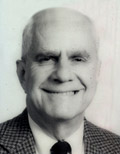
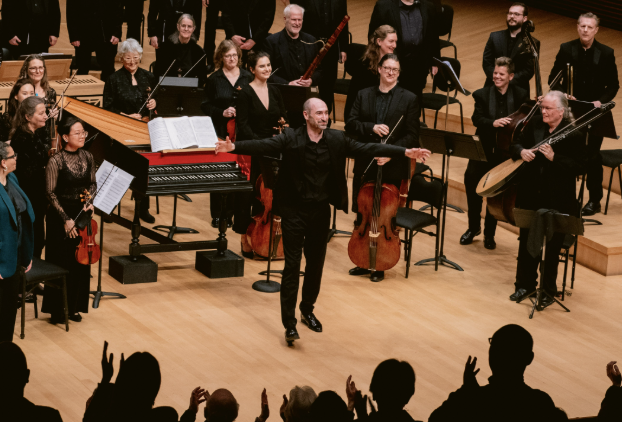
We are excited to announce the release of our new recording, Beethoven: Symphonies Nos. 4 & 7 (purchase your copy here). As with previous releases from Philharmonia Baroque Productions, audio engineer David v.R. Bowles lent his considerable expertise for this recording. David tells how he came to work with Philharmonia and explains the process behind what he does.
My association with Philharmonia goes back to May 1988, when I joined the orchestra performing at festivals in Los Angeles and Ojai. I played cello with the orchestra for six seasons before making the transition to audio engineering, a field that interested me since childhood. In 1996 I produced my first studio recording with Philharmonia Baroque Orchestra (Vivaldi for Diverse Instruments). In the next two years I produced two more studio recordings with Philharmonia Baroque for BMG Classics (Rameau – Suites from Platée and Dardanus; Arne – Alfred). In 2001 I started recording the concerts in Berkeley.
Studio recordings are done with many takes in order to get a result approaching perfection – with four to six three-hour sessions for each finished recording. However, in today’s economy most orchestras record live performances, which are then edited together. The results sound spontaneous, but can have more than their share of rough edges or extraneous noises.
One Philharmonia Baroque recording (Scarlatti – Cecilian Vespers) was also released on Avie as a hybrid SACD in 2005 (containing stereo and surround-sound versions on the same disc). That recording was the first that utilized a “patch session,” a common practice in commercial live recordings.
With Philharmonia’s recordings, only the two Berkeley performances can be used, as the other venues are too different acoustically and physically (for instance, the size of the stage areas vary considerably). Difficult passages might not go well in spite of everyone’s best efforts, or the performers are nervous. There are always extraneous noises: two bus lines on Durant and Dana streets, audience members coughing, dropping program books, or those forbidden phones going off during soft passages…
The main advantage of a patch session is that it is a safety net for everyone: knowing that there will be one more chance to cover difficult passages, starting and ending movements with absolute silence, trying out daring musical ideas which might not work in the performance. This dissipates a lot of tension!
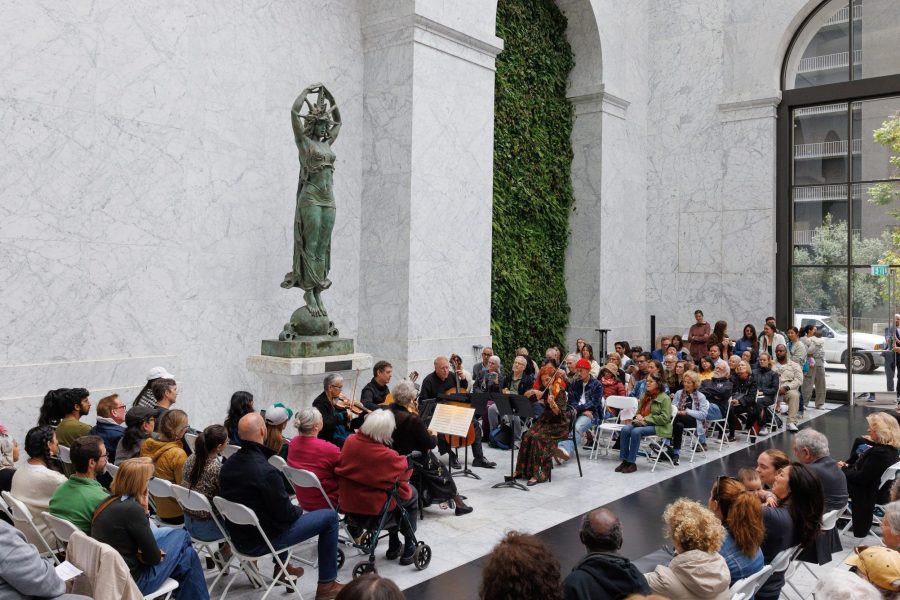
I’ve been asked why I use many microphones, particularly during concerts where a piece will be recorded for later release. Part of this is to compensate for acoustic shortcomings, as this church is not designed for live music. There are no reflectors above or to the sides of the orchestra, therefore the sound diffuses randomly, rather than projecting outwards. To compensate for this, I use support microphones on the outer edges and to the rear of the ensemble. Soloist microphones help to balance them favorably in relation to others who have larger voices. Microphones on the chorus help in clarity of diction even when the orchestra is playing loudly. Even a small amount of these spot microphones helps create a convincing “image” through the loudspeakers.
It has been a pleasure working with Philharmonia Baroque Orchestra over the years, watching (and hearing) the orchestra progress from a talented local group to an internationally renowned ensemble that serves as a role model to other organizations. I’m happy to have played a part in making the Philharmonia Baroque Productions recordings critically successful; starting with enthralling performances has made my task a lot easier!
- David v.R. Bowles
David v.R. Bowles is a GRAMMY-nominated Classical recording producer and engineer. His recordings have been named “Record of the Month” by Gramophone Magazine and Opera News, and ”Record of the Year” by The New York Times, The New Yorker, Miami Clasica and Classical Candour. To learn more about David Bowles, his recording company, Swineshead Productions, LLC, and his work, please visit www.swineshead.com.


Music Director Nicholas McGegan on the Road
In early May, Nic appears with the Nashville Symphony Orchestra to perform Mendelssohn’s Elijah. Appearing with him are Yulia Van Doren and Thomas Cooley, who will also appear with Philharmonia this coming December in William Boyce’s Solomon. “Music doesn’t get any more fun than this!” says McGegan as he looks forward to working with these talented performers.
In August, Nic visits Hungary to conducts four Haydn symphonies. “I first visited Eszterháza, the Hungarian summer palace of the Eszterházy family, in 1982 on the occasion of the three hundredth birthday of Joseph Haydn,” says Nic. “Since then I’ve been back many times performing in the magnificent music room which has recently been restored to its former glory. The last time I was there the present prince, Antál, was in the front row. It is always most humbling for me to think that those walls first heard that music over two hundred years ago when Haydn himself conducted.”
Only a few days later, Nic leads the Los Angeles Philharmonic at the Hollywood Bowl. “One thing I never get used to is the sheer size of the audience – sometimes as many as 15,000 people. Almost as many as go to an entire season of Philharmonia are there on one night!” On the program this year are works by Mozart and Beethoven, including the latter’s First Symphony.
Two other highlights of the summer are Nic’s visits to the Aspen Music Festival and the Music Academy of the West in Santa Barbara. “In both cases,” he says, “I get to work with wonderful students from around the world. Their energy and enthusiasm is a terrific tonic.”
For more news from Nicholas McGegan, please visit his website.